

The best deep cabinet storage ideas start with a simple truth: deep cabinets are not the problem, invisible storage is. If items disappear in the back, tip over, expire, or get bought twice, the fix is usually better access, better zoning, or a better cabinet layout.
Why deep cabinets become wasted space
Deep cabinet storage solutions work when they match the cabinet type, the reach distance, and the items inside. Standard fixed shelves fail because they create one large dark zone instead of usable layers, so canned goods vanish, pans stack badly, and vertical space sits empty.
Deep cupboard storage ideas need to change by location, because a straight lower cabinet, a blind corner, an upper cupboard, a pantry shelf, and a deep drawer all fail in different ways. A lower cabinet usually needs pull-forward access, while a tall pantry shelf usually needs categories and visibility instead of one open pile.
The right fix depends on five measurements: interior width, interior depth, usable height, door opening width, and hinge or obstruction clearance. Under-sink areas also need a plan around plumbing, while corner cabinets need a plan around their blind spot rather than their outside size.
Some deep kitchen cabinet storage solutions are organizational, and some are structural. Bins, risers, turntables, and dividers can fix clutter, but inaccessible blind corners, too few drawers, and poor pantry placement are layout problems that are better solved in a renovation.
First, measure your cabinet before buying anything
The inside measurement matters more than the cabinet label or exterior size. Measure the interior width, interior depth, and usable height at the narrowest point, because face frames, hinges, pipes, and shelf supports reduce the space your organizer can actually use.
A pull-out or bin needs a little breathing room to move freely and avoid scraping the frame, so do not buy to the exact interior dimension. Leave a small clearance on each side and at the front or back for smooth movement .
Deep cabinets usually work best with two zones instead of one. Plan a front access zone for daily-use items and a back-stock zone for overflow, bulk items, or occasional-use pieces.
A measuring checklist prevents the most common mistake: buying organizers that fit online but not in the real cabinet. Record shelf thickness, hinge swing, door opening width, and any plumbing, outlets, or support posts before you buy a kitchen cabinet shelf organizer.
Simple measuring checklist
- Interior width at the narrowest point
- Interior depth from inside the door line to the back wall
- Usable height between shelves or from shelf to frame
- Door opening width, not just cabinet width
- Hinge clearance and face-frame obstruction
- Plumbing or outlet obstructions under the sink
- Shelf thickness if you plan clip-on or under-shelf accessories
How to choose the right organizer: a decision tree by cabinet type and use case
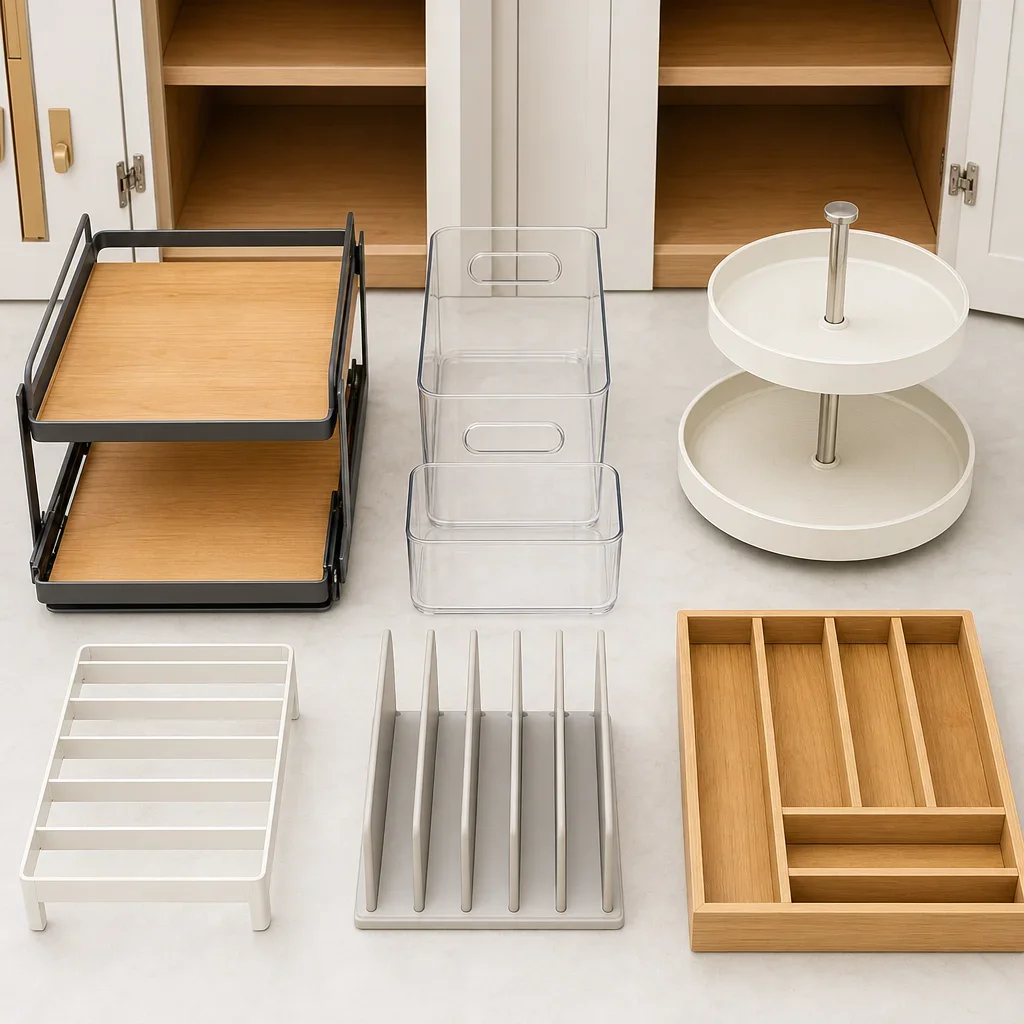
The best deep kitchen cabinet storage solutions depend on four choices: shelf or drawer, straight or corner, food or cookware, and everyday or occasional use. Once you answer those, the right organizer is usually obvious.
Pull-out shelves are best for heavy items in lower cabinets because they bring the back of the cabinet to you. They suit pots, small appliances, mixing bowls, and pantry back stock when bending and reaching are the main problem.
Clear bins are best for grouped pantry categories because they contain loose items and pull forward in one motion. They work well for snacks, baking supplies, packets, bottles, and lunch items, especially in rental-friendly projects.
Lazy Susans are best for awkward corners and for short jars or bottles that get lost behind each other. Oils, vinegars, sauces, nut butters, and condiments are a strong fit because rotation solves both visibility and reach.
Risers and tiered shelves are best for short items that need sight lines rather than depth. Cans, spice jars, and small pantry goods become easier to see when the back row sits higher than the front.
Vertical dividers are best for flat items that collapse into messy stacks. Baking sheets, cutting boards, trays, platters, lids, and cooling racks store better upright than piled.
Drawers outperform shelves when you are redesigning a kitchen around daily use and accessibility. A drawer gives full visibility from above, while a fixed shelf gives partial visibility from the front only.
Organizer decision table
| Cabinet type / use case | Best organizer | Why it works | Rental-friendly |
|---|---|---|---|
| Deep lower straight cabinet | Pull-out kitchen cabinet organizer | Brings heavy items forward | Sometimes |
| Deep pantry shelf | Clear handled bins | Groups categories and pulls forward | Yes |
| Deep upper cabinet | Shelf riser or light bin | Improves visibility without overloading | Yes |
| Deep corner cabinet | Lazy Susan or corner pull-out | Uses awkward back space | Some options |
| Deep drawer | Peg system or dividers | Stops sliding and piling | Yes |
| Bakeware cabinet | Vertical dividers | Stores trays upright | Yes |
| Under-sink cabinet | Stackable drawers and bins | Works around plumbing | Yes |
| Narrow deep pantry cabinet | Slim bins or slide-outs | Uses depth without blockages | Some options |
Best deep cabinet storage solutions by zone
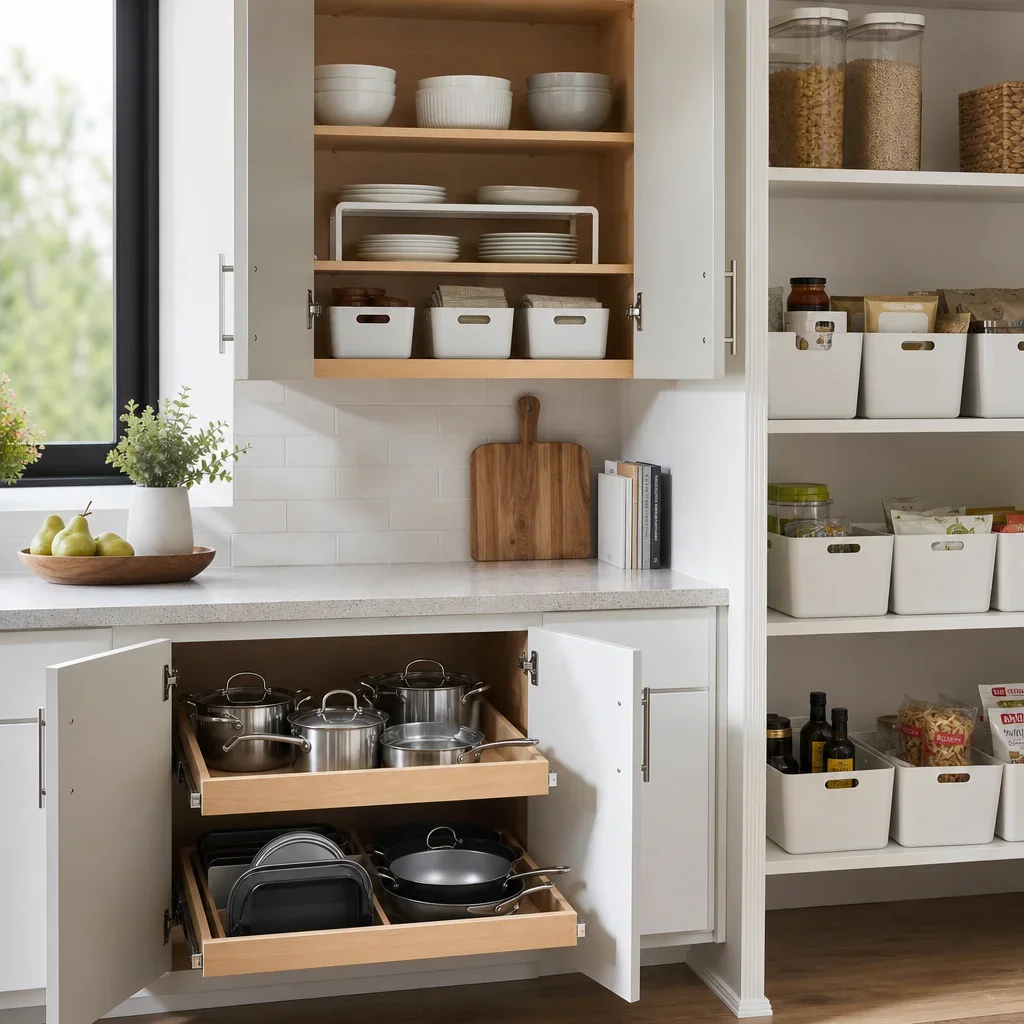
Lower cabinets work best when the contents come to you. Pull-out trays, deep bins with handles, pan organizers, and vertical tray dividers turn the back half of the cabinet into usable space instead of dead space.
Upper cabinets work best when they hold lighter items and clear categories. Shelf risers create a second level, while labeled bins with handles let you pull down one grouped set instead of reaching into the back.
Deep pantry shelves work best with categories, not rows. Bins for breakfast, snacks, baking, grains, canned goods, sauces, and back stock keep the shelf readable and reduce duplicate buying.
Deep drawers need internal structure or the contents slide into one heavy pile. Peg systems, adjustable dividers, lid separators, and nested bins make deep drawers useful for dishes, containers, linens, or pantry overflow.
Deep corner cabinet storage solutions need mechanics that match the corner shape. Pie-cut turntables, kidney-shaped organizers, half-moon pull-outs, and swing-out systems each solve a different kind of corner access problem.
Narrow deep cabinets need slim organizers instead of wide baskets. A narrow pull-out, narrow bins, or bottle rows can use the full depth without forcing you to unpack the whole cabinet to reach one item.
Under-sink cabinets work best with leak-safe bins, stackable drawers, and vertical caddies that respect the plumbing path. The space is deep, but the obstruction pattern matters more than the depth itself.
What goes in the front, middle, and back
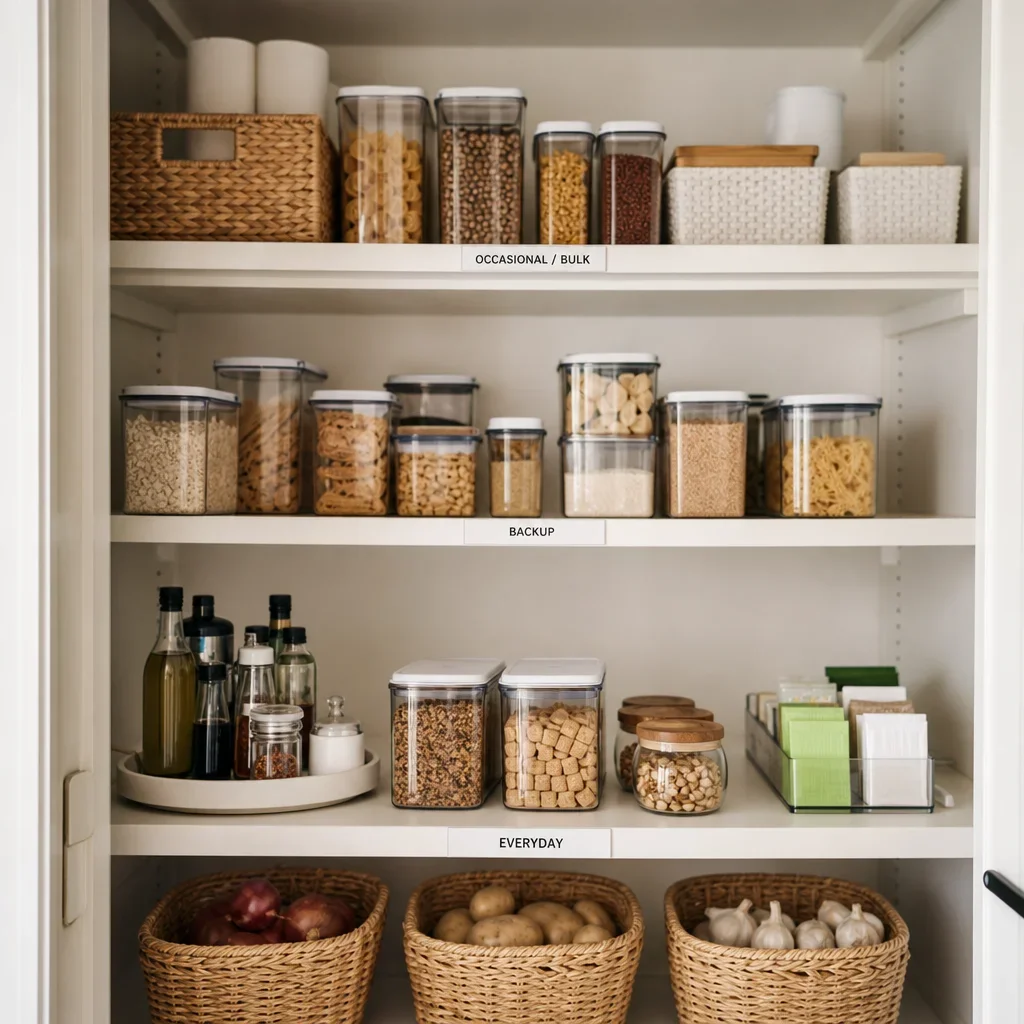
The front of a deep cabinet should hold daily-use items because this is the lowest-effort access zone. Put grab-and-go foods, mixing bowls, cookware used weekly, lunch items, and cleaning supplies you reach for often at the front.
The middle should hold weekly-use backups and medium-frequency items because it is still reachable without becoming prime space. Extra pasta, spare containers, overflow snacks, and medium-weight appliances fit well here.
The back should hold occasional-use items and true back stock because this is the slowest zone to access. Seasonal serving pieces, bulk refills, holiday platters, and rarely used gadgets belong at the back.
Heavy, fragile, or leak-prone items do not belong in awkward back zones. Cast iron, fragile glassware, and open cleaning liquids become harder to lift safely when they are stored low and deep.
Short shelf-life items should face forward first to reduce waste. A simple first-in, first-out system keeps older pantry goods at the front and newer replacements behind them.
How to organize deep pantry shelves so food does not disappear
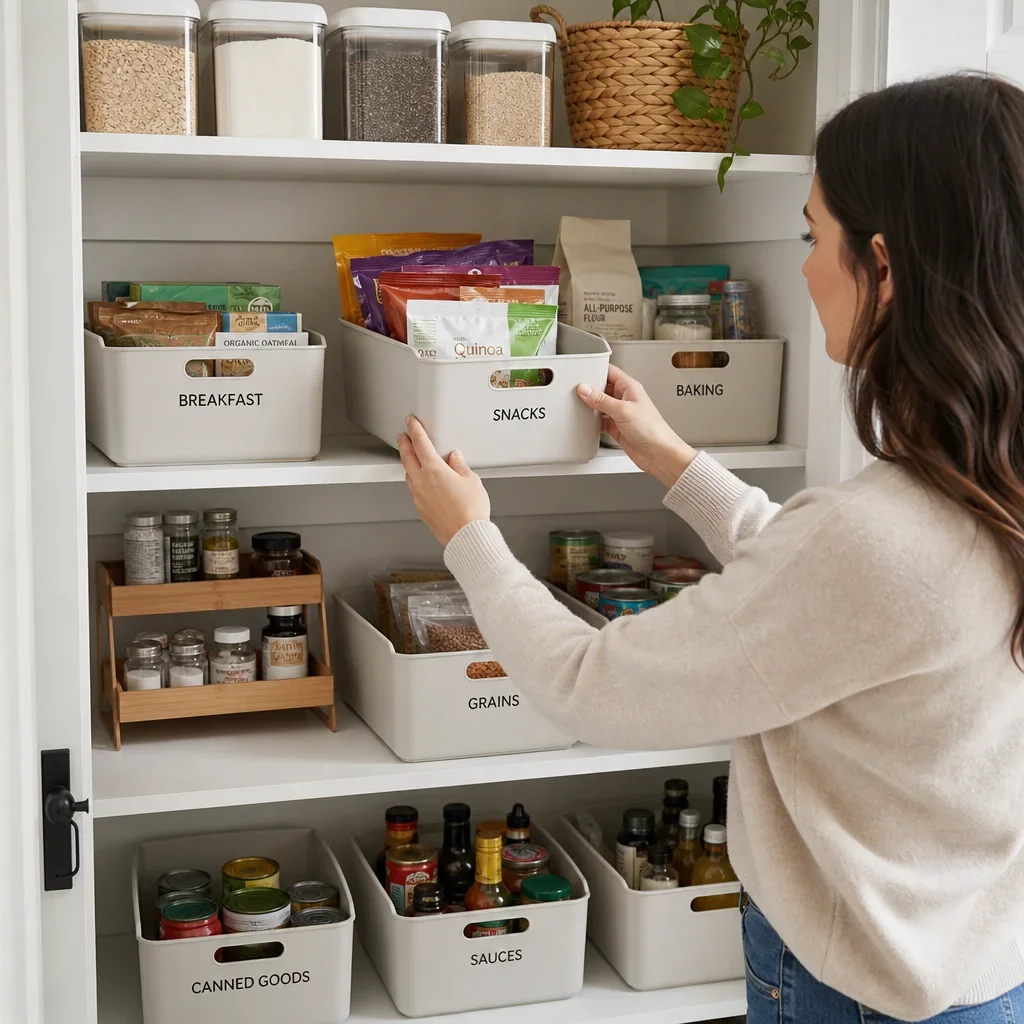
Deep cabinet storage ideas for pantries work best when you store by category, then by frequency. Create zones for breakfast, snacks, baking, grains, canned goods, sauces, lunch prep, and back stock so every item has one home.
Handled bins make deep pantry shelves easier to access because you pull the category forward instead of fishing through a dark back row. This is one of the simplest deep cupboard storage ideas on a budget because it does not require drilling or hardware.
Tiered risers help cans and jars only when the shelf is stable and the items are short enough to sit securely. They improve visibility, but they are a bad fit for tall bottles, soft bags, or wobbly stacks.
Turntables work best for jars and bottles that jam together in corners. Oils, vinegars, condiments, sauces, and nut butters are easier to see and use when they rotate into view.
A weekly quick reset and a monthly deeper reset keep pantry systems functional over time . The quick reset handles misplaced items, while the deeper reset catches duplicates, expired goods, and category drift.
Pantry mistakes to avoid
- Over-decanting everything into matching containers
- Mixing categories on the same shelf
- Stacking items too high to pull safely
- Putting daily-use items on top shelves
- Keeping unlabeled back stock in the rear of deep shelves
- Building deep rows of cans without containment
Deep corner cabinet storage solutions that actually work
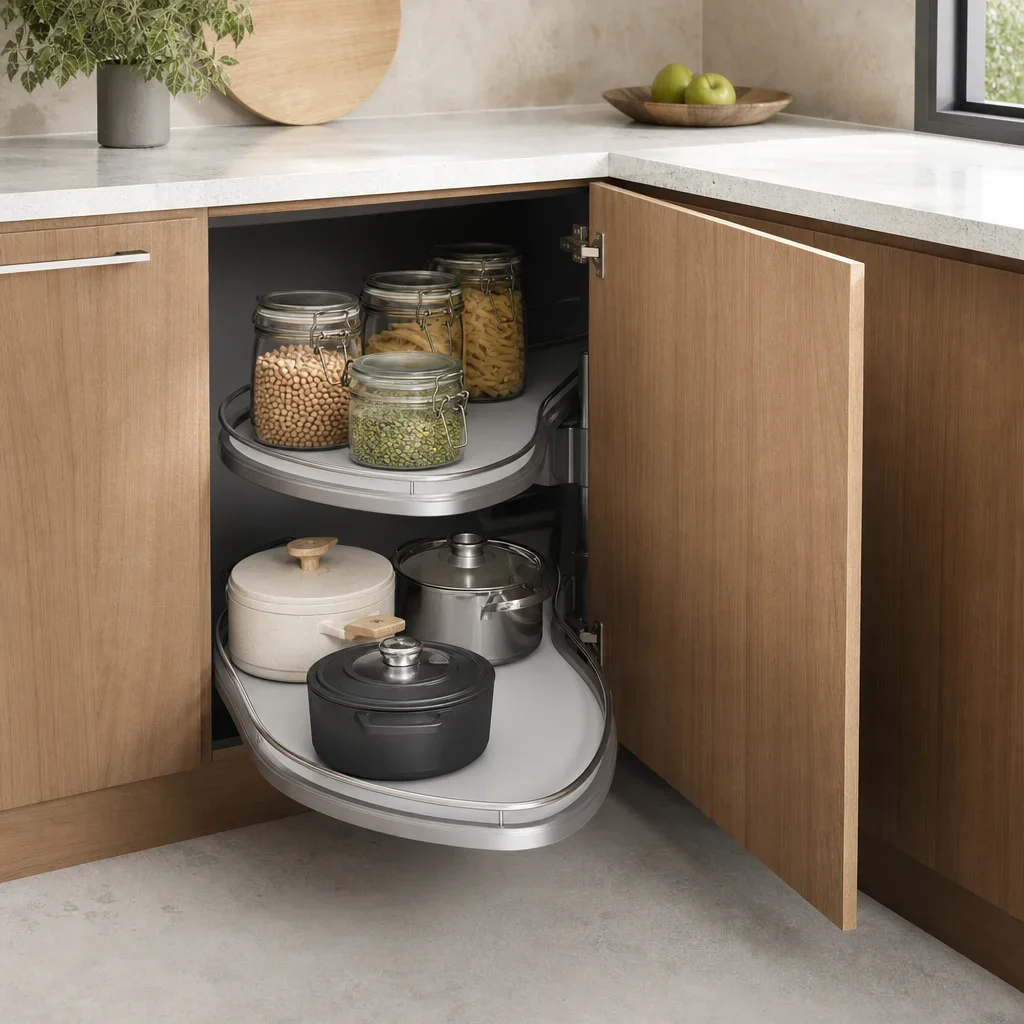
Deep corner cupboard storage ideas need a different approach because corners fail from geometry, not just clutter. The blind spot and triangular reach make standard shelves inefficient even when the cabinet looks large.
A rotating tray works best when the corner holds bottles, jars, or smaller pantry items that benefit from visibility. Rotation is simple, readable, and usually easier to maintain than a deep stacked corner.
A half-moon or swing-out system works best when the corner stores cookware or larger kitchen items that need guided movement. These systems cost more than a simple bin, but they solve reach better in hard-to-access base corners.
Bins can work in a corner cabinet when they contain larger grouped items instead of tiny loose pieces. Loose packets, spice jars, and single gadgets disappear in blind corners unless they are contained.
A renovation is sometimes the cleanest fix for extra deep cabinet storage solutions in corners. Drawer-heavy layouts, better corner hardware, or redesigned cabinetry can turn wasted corner volume into usable daily storage.
Storage ideas by item category
Spices store best in tiered risers, drawer inserts, slim pull-outs, or a small turntable depending on the cabinet shape. Deep uncontained rows are the worst option because labels disappear behind each other.
Canned goods store best in stepped risers, can dispensers, or bins grouped by meal type. A long deep row of cans hides inventory and makes expiration control harder.
Pots and pans store best on pull-out trays, vertical pan racks, or stable nested sets with lid separation. Deep shelves become frustrating when heavy pans are stacked three or four deep without access control.
Lids, bakeware, cooling racks, and cutting boards store best vertically because upright storage uses depth without unstable piles. Dividers are usually better than stacks for anything flat and rigid.
Bottles, jars, and containers store best in bins or on turntables because both methods reduce tipping and make labels visible. This is one of the best deep kitchen cabinet storage solutions for condiments and pantry staples.
Mugs and glasses store best with shelf risers only when clearance and weight are appropriate. Doubling a shelf is useful, but cramped vertical space creates chipping and awkward handling.
Small appliances should be stored by frequency and weight, not just by size. The heaviest or most-used appliance should sit at waist to counter height when possible, while occasional appliances can move deeper into lower storage.
How to maximize vertical space in deep cabinets and tall cupboards
Vertical space should be layered, not piled. Risers, stackable bins, under-shelf baskets, and adjustable shelves create usable levels, while tall unstable stacks create frustration and breakage.
Upper shelves in tall deep cabinets should hold lightweight, lower-frequency items in clearly labeled bins. Paper goods, serving pieces, and seasonal pieces fit better there than everyday dishes or heavy cookware.
Extra deep kitchen cabinet storage solutions work when each vertical layer still stays reachable. If you have to unload the entire front layer to access the second layer, the organizer is adding complexity instead of function.
A step stool improves safe access to high shelves, but it does not make high shelves ideal for daily use. Reserve the highest zones for infrequent items rather than trying to force full-capacity storage into every inch.
Deep drawer organization: what to do when drawers are too deep
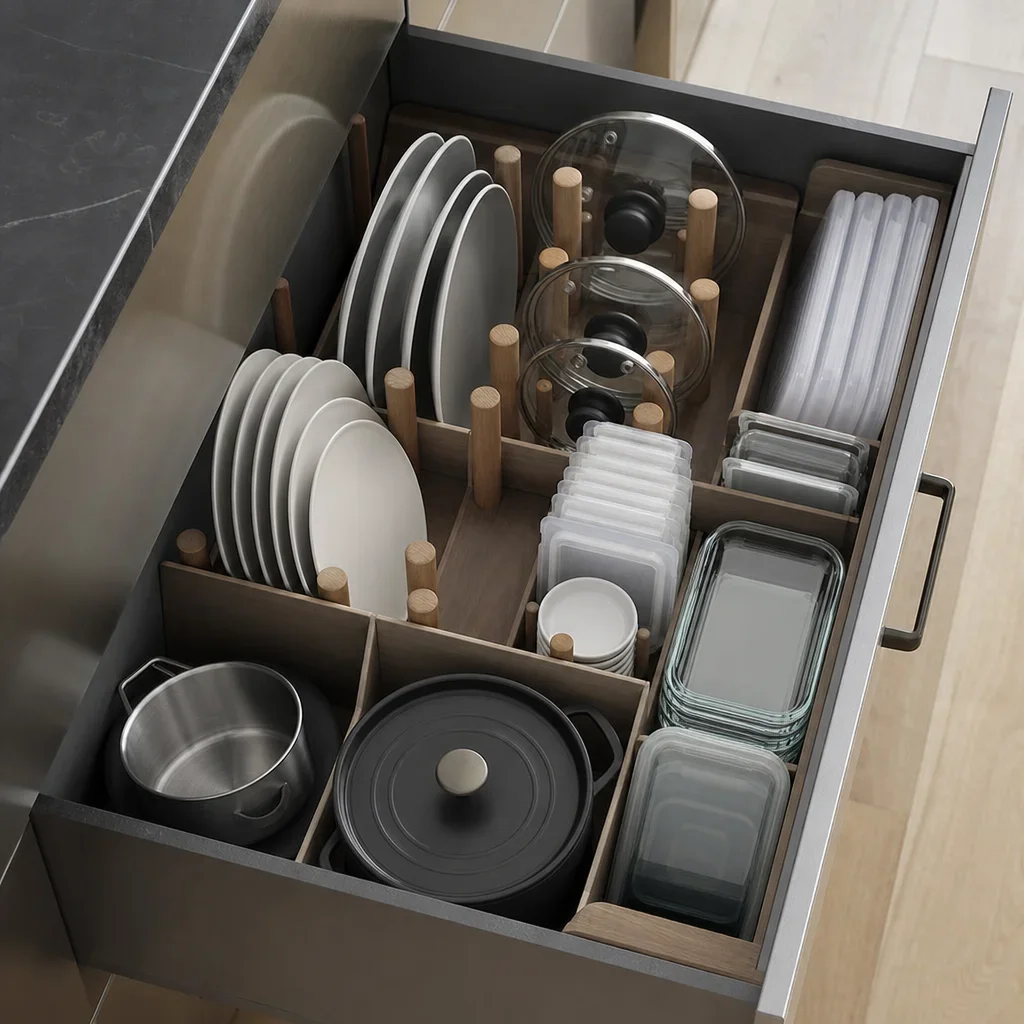
Deep drawers need internal subdivision or the contents slide into open piles. Dividers, peg systems, plate holders, pot-lid organizers, and nested bins turn one large cavity into smaller controlled zones.
Deep kitchen cabinet storage solutions for drawers are best when the drawer matches the item shape. Pots, pans, food containers, dishes, linens, and pantry overflow all work well if the drawer has dedicated lanes or compartments.
Open piles are the main reason deep drawers fail over time. Mixed categories, overly tall stacks, and heavy loose items turn a useful deep drawer into a catch-all.
How to maximize storage in deep kitchen drawers comes down to one rule: contain by function, not by category alone. A container drawer may need separate zones for lids, bases, wraps, and clips even though all four belong to one category.
Rental-friendly and no-drill ideas
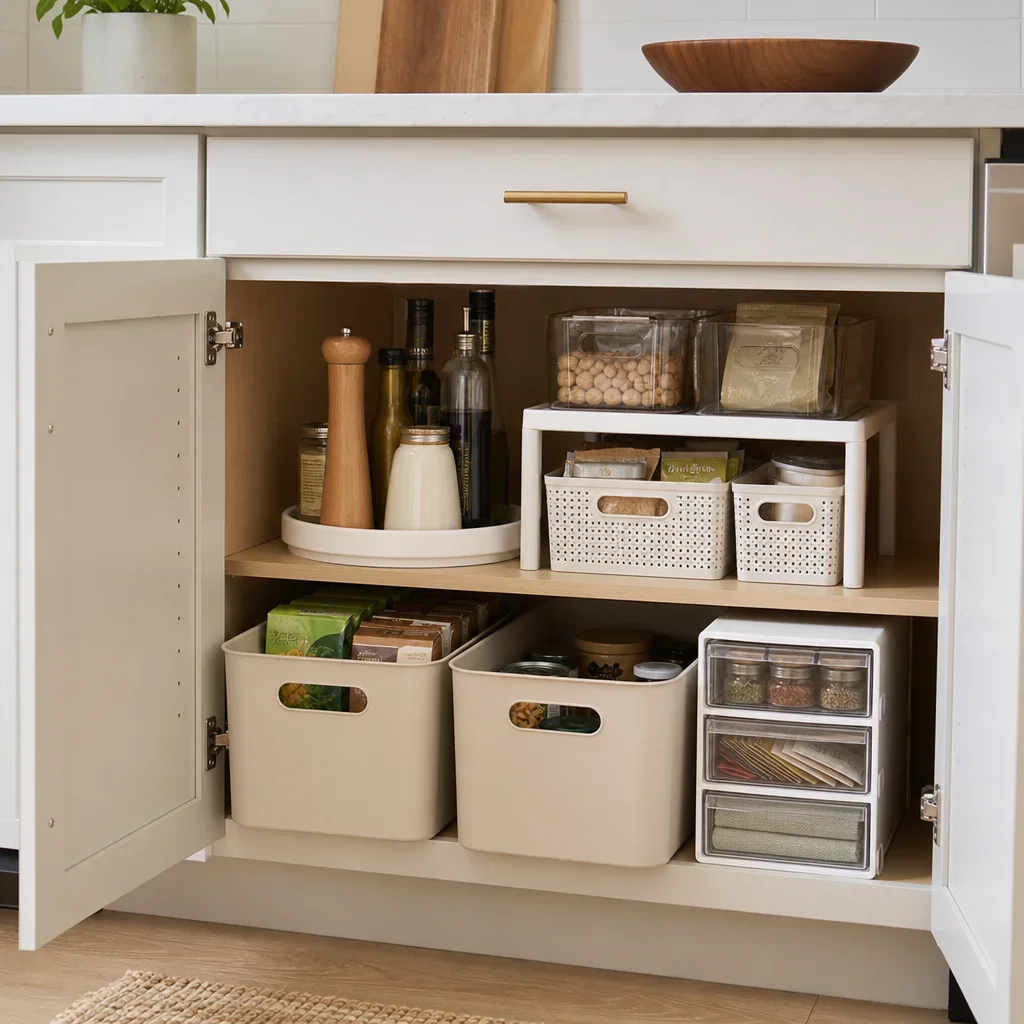
Rental-friendly deep cabinet storage ideas diy projects should be removable, washable, and easy to reuse in a future home. Freestanding bins, handled baskets, turntables, shelf risers, removable drawer organizers, and tension-based dividers are usually the safest starting point.
Adhesive add-ons can work for light-duty items, but humidity and heavy loads can shorten their life. Use them carefully in kitchens and avoid depending on them for anything heavy or breakable.
Deep kitchen cabinet storage solutions diy projects work best when they solve access before appearance. A simple labeled bin system usually outperforms a decorative but rigid setup that does not suit the cabinet dimensions.
Budget-friendly deep cupboard storage ideas on a budget include repurposed shoebox-style bins, dollar-store baskets, simple file sorters for bakeware, and basic turntables. The organizing principle matters more than the brand.
Budget guide: how much deep cabinet organizers can cost
Basic organizer refreshes usually start with bins, risers, and simple dividers, and these often land in the roughly $20 to $150 range for a small cabinet or single-zone upgrade . The final total depends on material quality, quantity, and whether you are organizing one cabinet or a whole pantry.
Mid-range upgrades usually include sturdier turntables, can systems, better drawer dividers, or one or two slide-out shelves, and these often run from about $150 to $600+ for a multi-zone project . Installation, delivery, and taxes may be separate.
Higher-end upgrades usually involve multiple pull-outs, drawer retrofits, custom inserts, or cabinet modifications, and costs can move from several hundred dollars into the low thousands depending on scope and hardware . Once you reach that point, it is worth asking whether a layout change would solve the problem more permanently.
A redesign makes more sense than more organizers when the access problem comes from cabinet layout instead of clutter. Blind corners, too few drawers, poor pantry planning, and awkward appliance placement are common examples.
A step-by-step checklist to organize any deep cabinet
The fastest way to organize a very deep cabinet is to empty it completely and rebuild it with zones. Starting from zero exposes duplicates, expired goods, broken organizers, and categories that never worked.
Clean the cabinet and check for shelf damage, leaks, or stains before you restock. Under-sink cabinets especially need a quick inspection because moisture changes what organizers are safe to use.
Sort everything by category and by frequency of use before you buy organizers. Daily-use, weekly-use, occasional-use, and back-stock items need different positions inside a deep cabinet.
Measure the cabinet, then choose one organizer type per problem instead of layering random products. Most cabinets need one primary solution, such as a pull-out, bin system, riser, or divider, plus labels only where repeat maintenance matters.
Assign front, middle, and back zones before you restock. This placement rule does more to stop lost items than buying more accessories.
Contain small items in bins or dividers so they move as a group. Loose pouches, packets, lids, spice jars, and snacks are the first things to disappear in a deep shelf.
Put heavy items low and frequent-use items within easy reach. Accessibility matters more than squeezing every last inch of volume from the cabinet.
A weekly five-minute reset and a monthly review keep the system usable . Deep storage fails slowly, so small maintenance beats a major reorganization every few months.
Sample layouts for different households
A single or couple household usually needs less back stock and more flexible entertaining storage. That makes deep cabinet storage ideas easier to keep simple: fewer categories, more room for small appliances, serving pieces, or pantry overflow.
A family household needs visible snack zones, lunch-making access, and category duplication in busy areas. Kid-safe lower storage and easy breakfast access usually matter more than matching containers.
A bulk-shopping household needs a front-use zone and a true back-stock zone to avoid expiry and overbuying. Larger bins, FIFO rotation, and separated refill storage become more important as quantity increases.
A small kitchen needs every deep cabinet to do one job clearly. Frequency-based placement and careful vertical layering matter more than trying to make every cabinet hold every category.
A mobility-conscious household usually benefits more from drawers, pull-outs, and lower accessible storage than from deep fixed shelves. In that case, the best deep cabinet storage solutions may be renovation-led rather than organizer-led.
When organization is not enough
Some deep cabinet problems are really kitchen design problems. Inaccessible blind corners, awkward workflow, too few drawers, poor pantry planning, and chronic under-sink conflicts are signs the storage issue comes from the layout.
Renovation-led fixes can replace deep shelves with drawers, add custom pull-outs, redesign pantry zones, upgrade corner hardware, and align cabinet depth with how the kitchen is actually used. That is a longer-term fix, but it creates permanent usability instead of repeated workarounds.
For Toronto and GTA homeowners planning a kitchen remodel, this is where storage should be designed around cooking habits, family size, and accessibility rather than added later as an afterthought. A good design-build renovation can solve the dead space itself, not just hide it.
If your cabinets are structurally awkward, not just cluttered, a design consultation can help you compare organizer fixes against a more permanent remodel plan. True Form Reno handles full kitchen and home renovation work across Toronto, with storage planning built into the design process.
FAQ
What to do with cabinets that are too deep?
Use access tools instead of open stacking. Pull-outs, bins with handles, risers, dividers, and front/middle/back zoning turn extra depth into usable storage.
How do I organize very deep kitchen cabinets?
Store daily-use items in front, weekly-use items in the middle, and occasional or bulk items in the back. Then match the organizer to the cabinet: pull-outs for lower cabinets, bins for pantry shelves, and dividers for bakeware.
What are the best storage solutions for deep pantry cabinets?
Handled bins, tiered risers, can organizers, turntables, and category labels usually work best. The goal is pull-forward access and visibility, not just more containers.
Should I use bins, pull-outs, or Lazy Susans in deep cabinets?
Use bins for grouped pantry items, pull-outs for heavy lower-cabinet storage, and Lazy Susans for corners, jars, and bottles. The right choice depends on cabinet shape, reach, and what you store.
How do I stop items from getting lost in the back of a cabinet?
Create zones and containment. Small loose items should go in bins or dividers, and short shelf-life items should stay at the front in FIFO order.
How do I measure a cabinet before buying organizers?
Measure interior width, depth, and usable height at the narrowest point. Also check door opening width, hinge clearance, shelf thickness, and any pipes or obstructions.
What should go in the front versus the back of a deep cabinet?
Keep frequent-use items in front, medium-use items in the middle, and occasional-use or bulk items in back. Avoid storing heavy or fragile items in hard-to-reach rear zones.
How do I organize a deep corner cabinet?
Use a turntable for jars and bottles, or a corner pull-out for cookware and larger items. Avoid loose small items unless they are fully contained.
What are pantry design mistakes to avoid?
Open rows, mixed categories, over-decanting, too many unlabeled containers, tall unstable stacks, and putting daily-use items on high shelves are the most common mistakes.
What can I do if my drawers are too deep?
Add internal structure. Peg systems, dividers, nested bins, and plate or lid organizers keep contents from sliding and piling up.
Are there no-drill storage options for renters?
Yes. Freestanding bins, risers, turntables, removable drawer inserts, and some tension-based dividers are simple no-drill options.
When is it better to renovate instead of adding organizers?
Renovate when the real issue is layout: blind corners, poor workflow, too few drawers, awkward cabinet depths, or pantry space that was never planned around how you live.
The best system is the one you can maintain. Start with one cabinet, measure it properly, and fix access before you buy more containers.


