 Instagram
Essential Warranties and Guarantees Toronto Homeowners Should Expect from Design‑Build Contractors
A warranty in the renovation context is a written promise from a contractor to repair or correct defects in workmanship or installation for a set period. For Toronto homeowners, that written assurance reduces financial exposure and safety risk after the job is complete. This guide walks you through what warranties usually cover, why they matter for houses and condos across the GTA, and how to read warranty language when comparing contractors. You’ll learn the differences between workmanship, manufacturer and structural warranties, how Ontario rules affect guarantees, and what to expect from a contractor’s claims process. We also explain how the design‑build model — with integrated documentation, fixed budgets and single‑point accountability — improves warranty outcomes. The sections below cover why warranties matter, the common warranty types you’ll see, True Form Renovations’ warranty details, relevant Ontario regulations, how design‑build reduces risk, and a short FAQ addressing homeowners’ most common questions.
Why Warranties Matter for Toronto Home Renovations
Warranties turn a contractor’s promise into a practical safety net that protects you from repair bills and lengthy service delays caused by defects, poor installation or non‑compliant work. A clear warranty lowers the chance of disputes by spelling out who fixes what, within which timeframe, and under what conditions — giving you financial clarity and confidence in your renovation. In Toronto and the wider GTA, where permits, condo rules and local weather add complexity, written warranties also help maintain resale value and reduce a home’s total cost of ownership. The next section breaks down the specific risks warranties commonly protect against and how those issues typically appear after a renovation.
What Risks Do Warranties Protect You Against?
Warranties mainly protect you from workmanship defects, premature material failures, code non‑compliance found after permits close, and water or weather breaches caused by poor installation. Workmanship problems may show up as uneven floors, poorly sealed windows or cabinet joints coming apart; manufacturer failures can include warped doors or broken appliances; and structural issues concern load‑bearing elements or foundations. Warranty timelines for assessment and repair limit the cost and disruption of long‑running problems and reduce the likelihood of legal escalation. Clear exclusions set realistic expectations, and knowing typical remediation paths and response windows helps you pick a contractor whose warranty offers meaningful protection and timely resolution.
How Do Warranties Protect Your Renovation Investment?
Warranties protect the money you put into a renovation and can make your property more attractive to future buyers. When a contractor promises to fix defects within a defined period, buyer perceived risk drops and marketability improves — which can lead to faster sales or better offers. Covered repairs are usually completed without extra labour costs, reducing ongoing maintenance expenses and preserving the long‑term value of new systems and finishes. With that investment rationale in mind, the next section explains the specific warranty types you should expect on Toronto renovation projects.
What Types of Renovation Warranties Should Toronto Homeowners Expect?

Renovation warranties generally fall into three categories: workmanship, manufacturer/material and structural — each with different providers, lengths and remedies. Workmanship warranties cover the contractor’s labour and installation; manufacturer warranties cover product defects and performance; and structural warranties address major safety‑critical elements and typically last longer. Knowing who is responsible for each type prevents confusion when problems arise and clarifies whether you should contact the contractor, the product maker, or both. The list below summarizes these warranty types and what you can expect in practice.
- Workmanship warranties: Contractor‑backed coverage for installation and labour defects, typically 1–5 years.
- Manufacturer warranties: Supplier‑backed coverage for product failures or defects; durations vary by product and brand.
- Structural warranties: Longer coverage for major structural elements, often backed by insurers or formal contractual guarantees.
These distinctions determine remediation paths and documentation needs. The table that follows gives a quick comparison of responsibilities and typical durations for easy reference.
| Warranty Type | Typical Duration | Who Provides It | What It Covers |
|---|---|---|---|
| Workmanship | 1–5 years | Contractor | Installation and labour defects (for example, tiling, trim, installation errors) |
| Manufacturer / Material | Varies (depends on the product) | Manufacturer | Product defects and performance failures (for example, windows, appliances) |
| Structural | 7 years | Contractor, insurer or specialized warranty provider | Major load‑bearing failures, foundation and primary structural elements |
This comparison helps homeowners match contract language to real‑world protection. Next, we look more closely at workmanship coverage and what to expect for individual components.
What Is a Workmanship Warranty and What Does It Cover?
A workmanship warranty is the contractor’s commitment to repair defects caused by labour or installation mistakes. It typically covers how items were installed rather than the materials themselves. Common inclusions are drywall finishing, flooring installation, cabinetry alignment and tile setting; remedies usually involve repair or replacement by the contractor at no labour cost within the warranty period. Pay attention to timelines for initial response and remediation — you should expect documented response windows (for example, an initial assessment within a set number of business days) and a clear scheduling process. Knowing the difference between workmanship and manufacturer coverage helps you gather the right paperwork when you file a claim, which we outline later.
How Do Material and Manufacturer Warranties Differ?
Manufacturer warranties cover the product — defects in materials, performance failures or premature degradation caused by manufacturing. Examples include window seal failures, appliances that stop working, or flooring with manufacturing defects. These claims are typically handled by the manufacturer and often require proof of purchase and serial numbers. Contractors commonly assist with manufacturer claims by coordinating paperwork and returns, but you should keep receipts, product manuals and warranty cards. Knowing which party provides which warranty speeds up resolution and avoids overlap between contractor and manufacturer remedies.
What Are Structural Warranties and Why Are They Critical?
Structural warranties protect you from failures in load‑bearing components and elements essential to the building’s integrity, such as foundations, major framing and load‑bearing walls. Because structural defects can take longer to appear and carry higher safety and cost implications, these warranties usually run longer than standard workmanship promises. For additions or projects that alter structural systems, insist on clear documentation, inspection records and, where appropriate, third‑party structural reviews so any future claim has a solid evidentiary trail. With these warranty types clarified, the next section describes True Form Renovations’ warranty program and component coverage.
What Does True Form Renovations’ Warranty Program Include?
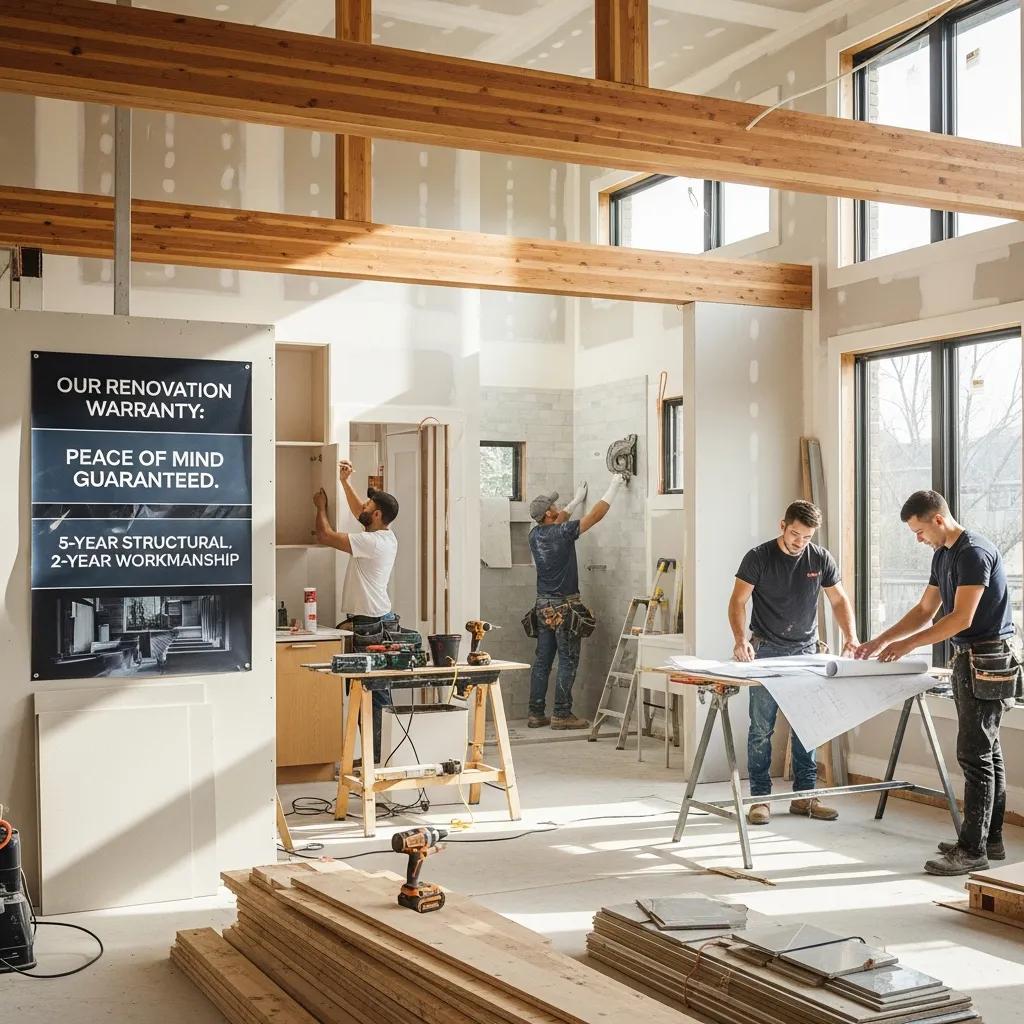
True Form Renovations provides clear workmanship warranties tailored to project type, giving homeowners a contractor‑backed commitment to fix installation defects and to help manage related manufacturer claims. For residential projects, True Form offers a 5‑year workmanship warranty covering a broad range of installation items. For condo renovations, a standard 2‑year workmanship warranty applies to reflect access and building management constraints. Coverage is backed by documented claims processes and an emphasis on fixed‑budget contracts and coordinated permit handling to lower the chance of post‑completion issues. The table below lists common residential components, the type of coverage under the 5‑year warranty, and key notes or exclusions to expect.
| Component | Type of Coverage | Duration / Notes / Exclusions |
|---|---|---|
| Flooring (installation) | Workmanship | Covered for 5 years; excludes normal wear and damage from misuse |
| Drywall & Finishes | Workmanship | Covered for 5 years; includes repair of finishing defects caused by installation |
| Cabinets & Millwork | Workmanship | Covered for 5 years for installation defects; manufacturer damage handled via supplier warranty |
| Windows (installation) | Workmanship + coordination | Installation defects covered for 5 years; manufacturer seal failures handled under the manufacturer warranty |
| Structural alterations | Workmanship / structural | Covered 7 years for workmanship related to structural work; excludes pre‑existing conditions and improper owner modifications |
This table makes it clear which items the contractor covers and which are the manufacturer’s responsibility. The sections that follow explain condo differences and common warranty limitations in more detail.
What Does the 5‑Year Workmanship Warranty Cover for Residential Projects?
Under the residential 5‑year workmanship warranty, True Form pledges to repair defects in installed systems caused by labour or installation practices — for example, misaligned millwork, improperly installed flooring, or water intrusion resulting from faulty installation. The warranty specifies remediation timelines and the contractor’s role in coordinating any necessary manufacturer claims. Insurance and liability coverage support warranty fulfilment, and homeowners are asked to report defects promptly with supporting documentation — photos and purchase or installation records — to start an assessment. Clear response windows and closure criteria reduce dispute risk and make the warranty a practical safeguard for homeowners.
How Does the 2‑Year Workmanship Warranty Apply to Condo Renovations?
Condo renovations have different access rules, building approvals and shared systems; the 2‑year workmanship warranty for condo projects reflects those practical limits while still covering installation defects within the contractor’s scope. Coordination with condominium management or the board may be required before work or remedial access can occur, and the contractor documents approvals and scheduling to minimize disruption. Homeowners should expect the warranty to cover installation‑related defects while respecting condo rules, and to keep building approvals and notices as part of any claim package. Understanding these condo logistics sets realistic expectations for timing and access during remediation.
What Are the Common Exclusions and Limitations in Our Warranties?
Workmanship warranties typically exclude normal wear and tear, damage from misuse or accidental owner actions, and issues arising from client‑supplied materials unless agreed in writing. Exclusions also often cover cosmetic changes due to aging and problems caused by unrelated trades or owner alterations after project handover. To preserve coverage, follow maintenance recommendations and report defects within the stated warranty period — failing to report promptly or to maintain installed systems can void parts of a claim. Clear documentation and timely communication during the warranty period protect homeowner rights and simplify the contractor’s assessment and repairs.
How Do the Ontario Building Code and Tarion Affect Renovation Guarantees?
The Ontario Building Code (OBC) sets minimum safety and performance standards for construction and renovations and directly affects how contractors work and what homeowners should expect from warranties. Work that complies with the OBC supports warranty validity because non‑compliant installations can create safety risks and may void warranty coverage if the defect stems from code‑related issues. Tarion Warranty Corporation primarily governs new home builders and new home warranties and therefore generally does not apply to standard renovations; for renovation protection rely on contractor workmanship warranties, manufacturer guarantees and proper insurance. The table below summarizes regulatory entities and their relevance to renovation projects for quick reference.
| Regulatory Entity / Rule | Scope | Applicability to Renovations |
|---|---|---|
| Ontario Building Code | Minimum safety and construction standards | Applies to permitted renovations; compliance is important for warranty validity |
| Tarion Warranty Corporation | New home builder warranties and new home protections | Generally does not cover typical renovations; rare exceptions depend on legal definitions |
| Local permits / inspections | Municipal review and approval processes | Required for code‑impacting work; permits and inspections support warranty claims and provide compliance evidence |
This table reinforces that OBC compliance and proper permitting support warranty claims, while Tarion is not a default protection for renovation work. The next section explains how OBC compliance ties into renovation quality.
What Role Does the Ontario Building Code Play in Renovation Quality?
The Ontario Building Code prescribes minimum practices for structural integrity, fire separations, insulation, ventilation and other safety‑critical systems. When contractors follow the OBC and obtain required inspections, homeowners get documented evidence that supports warranty claims and lowers the risk an insurer or warranty provider will deny coverage for non‑compliant work. Design‑build contractors typically coordinate permits and inspections as part of their workflow, creating a stronger record to support warranty fulfilment. Knowing this compliance chain helps you choose contractors who treat code adherence as a core part of quality assurance.
Does Tarion Warranty Cover Home Renovations in Toronto?
No — Tarion mainly administers new home builder warranties and typically does not cover ordinary renovation work. Renovations are usually outside Tarion’s standard scope unless a rare legal definition reclassifies the work as a new home. For renovation projects, rely on contractor workmanship warranties, manufacturer guarantees and appropriate insurance rather than expecting Tarion protection. Contractors that provide clear, documented workmanship warranties and who coordinate manufacturer claims effectively create the practical protections homeowners need. The next section describes how a design‑build model can further strengthen those protections.
How True Form’s Design‑Build Model Improves Warranty Reliability

A design‑build contractor provides integrated design, permitting, budgeting and construction under a single team, which reduces handoffs and the failure points that commonly trigger warranty claims. Single‑point accountability makes it clear who is responsible for defects and simplifies the claims process for homeowners. Fixed budgets, documented change orders and coordinated permitting reduce the incentive for rushed work or scope confusion that lead to defects, and integrated permit handling supports OBC compliance — all of which reduce the frequency and complexity of warranty claims. The subsection below outlines the key documentation practices that support reliable warranty outcomes.
How Does Clear Documentation Support Warranty Claims?
Clear documentation — signed contracts, an itemized scope, fixed‑price budgets, manufacturer warranty certificates and final permits — creates an evidentiary trail that speeds assessment and remediation. Expect a handover package that includes the scope, warranty durations, manufacturer paperwork and maintenance instructions; these materials make it easier to determine whether a defect is covered by workmanship, manufacturer or excluded causes. Fixed‑price contracts and documented change orders limit disputes about what was agreed and help warranty teams prioritize repairs. Keeping this paperwork organized and accessible is your first step when making a claim.
- Signed contract with scope and warranty terms.
- Manufacturer warranty certificates and receipts.
- Final permits and inspection sign‑offs.
Together, these documents form the foundation for any effective warranty claim and make the process faster and more transparent.
What Is the Process for Making a Warranty Claim with True Form?
True Form follows a clear, step‑by‑step warranty process to reduce ambiguity and ensure predictable response times: report, assess, schedule, remediate and close. First, report the issue with photos and supporting documents; next, the contractor performs an initial assessment to determine responsibility and scope; then remediation is scheduled and completed, followed by verification and closure documentation. Warranty terms include expected response windows for assessments and scheduling to avoid open‑ended delays. Keep records of communications and preserve failed materials or components to simplify manufacturer coordination or insurer involvement.
- Report the issue with photos and invoices.
- Contractor performs an initial assessment and assigns responsibility.
- Schedule remediation and carry out repairs.
- Verify fixes and close the claim with documentation.
This stepwise approach promotes transparency and timely resolution. The section that follows answers frequent homeowner questions to reinforce practical understanding.
Common Questions About Toronto Renovation Warranties
Homeowners often want to know typical durations, how to include warranty terms in contracts, and whether warranties transfer on sale. The short answers below help you compare proposals quickly, with brief guidance on next steps.
What Is the Standard Warranty Duration for Home Renovations in Toronto?
Industry durations vary — workmanship warranties commonly range from one to five years, while structural coverage often extends longer. Manufacturer warranties differ widely by product. Contractor workmanship warranties in the two‑to‑five‑year range are increasingly common and signal confidence in craft. True Form Renovations explicitly offers a 5‑year workmanship warranty on most residential projects and a 2‑year workmanship warranty for condo renovations, which aligns with common industry practices and homeowner expectations.
How Should Warranty Terms Be Included in Renovation Contracts?
Warranty terms should be spelled out in the contract: state the duration, scope (what is and isn’t covered), the claims process with contact details and expected response windows, and any maintenance obligations required to preserve coverage. Add a clause describing coordination with manufacturer warranties and document retention requirements, and ensure change orders are appended and signed. Attach a checklist of required documents — receipts, product manuals and permits — to avoid ambiguity during a claim. Clear contract language reduces disputes and speeds remediation.
Can Warranties Be Transferred When Selling a Renovated Home?
Transferability depends on the warranty’s terms. Some contractor and manufacturer warranties can be transferred to a new owner if the transfer is documented; others cannot. When transfer is allowed, the seller usually provides written notice and the original documentation to effect the transfer. Buyers value transferable warranties as added assurance. Sellers should keep original warranty paperwork and include transferability language in the sale documents; checking the warranty’s fine print early avoids surprises.
- Check the warranty fine print for transfer rules.
- Keep original documentation and provide it to buyers.
- Notify the contractor or manufacturer in writing if transfer is allowed.
Following these steps makes transfer straightforward when permitted and enhances the property’s appeal to prospective buyers.
Beyond residential work, True Form Renovations also provides commercial general contracting services. Businesses can use the same design‑build expertise and warranty practices for commercial spaces, ensuring consistent quality and reliable protection across project types.
If you’re ready to plan a renovation with clear protections, True Form Renovations’ warranties and integrated design‑build process can help. Request a free estimate and ask about specific warranty details during your project proposal. Our approach — fixed budgets, coordinated permit navigation and single‑team accountability — aims to reduce defects and make any future warranty work straightforward, giving you real assurance when investing in home improvements.
